Wednesday, November 1, 2017

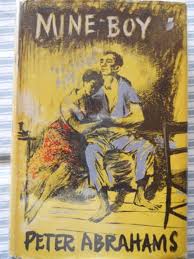
MINE BOY. By Peter Abrahams


The importance of this early novel from any black or coloured African in the pantheon of African literature can not be over emphasized. Pa Abrahams who sadly died this year after glimpsing becoming a Centenarian was a very good perceptive writer with sensitivity. 
Despite growing up in the hell of a racist enclave – where blacks were considered very inferior - he always managed to write from the “human” point of view with restraint and civility and great intelligence. This is obvious in this work as we zero in on Xuma and his metamorphosis into a man and thinker over the years. From a very simple, naïve country bumpkin he attains awareness late on in a way that would strike clanging chords among all readers…as it did over the decades, with the world realizing how “apartheid’ was a horrific, unbearable thing in South Africa. 
And the work is a fine read too, right from the beginning as Xuma arrives at Malay camp, gets to mix with a medley of people…he gets a job in the Mines and is struck with the way the life of whites – with their many comforts and appurtenants – contrasts sordidly with the life of blacks. Why should whites be free and drink liberally whilst blacks were constrained to carry passes in the land of their birth? And also arrested for selling and drinking “local drink”?
Leah, the powerful ‘Skokiaan queen’ is a splendid woman and somewhat takes the naïve Xuma under her wing. His initial naivety is charming, and his great strength very impressive too. Life would have been fairly okay if not for all the constrictive structures of racism in society. The descriptions are beguiling and unforgettable here, including the colourful weekends in the townships! Hark at the dancing sequences, coquetry, flirting and drinking. 
Xuma himself is not celibate as the story unfolds, and he is very much entranced and “in love” with Eliza who is presented as beautiful; but conflicted and eccentric as she “craves for the fine things of the whites” which she can never have. It is a haunting, somber aspect and we are happy for Xuma as things initially go well between him and Eliza - till she disappears! Eliza has gone…Yet the other woman, Maisy, is always there for Xuma and understands him and handles her own frustration with extraordinary selflessness and maturity. 
Xuma begins to think about things, and the irony is that it is a white man, Paddy, who conscientizes him and lets him fully realize that one should not believe in racial superiority or otherwise, and the “good things of life” should be for everybody, not only whites. That all men should be free and equal. If only it were so…the whole idea grips Xuma and he begins to think along these lines…man as man, never mind colour or race…goodness and fairness and freedom!
It is the making of Xuma, as a series of undesirable and tragic events unfold in the last part of the work. Xuma leads a rebellion in the mines at the end and is none the worse for it,; he is ready to settle down with Maisy at last (once he has left jail). This is grim and halcyon at the same time. A wonderful work indeed.
- Malome Eric

Friday, October 13, 2017

A SIMPLE LUST. By Denis Brutus


Denis Brutus, from southern Africa, was a very polished, assiduous poet. Think about "difficult" rather academic African poets – e.g Lenrie Peters, Wole Soyinka, Dambudzo Marechera - and most would surely plump for Brutus as belonging to this category. This early work of his clearly shows why most categorize him as a "protest poet" which was understandable in view of the egregious, horrifying apartheid system that held sway during that time in his homeland. Brutus created superb poetry despite all these strictures, and African poetry is the better for it. The celebrated poem, "A troubador I traverse..." showcases the poet at his best, as a sublime, subtle versifier. But this collection is redolent with all the accoutrements of fine poetry - personification, rhymes, stunning rhythms, litotes, metaphor, simile, and the entire gamut. An early giant of African poetry, Mr Brutus. Sadly, a few years ago, he and another poet of such ilk, Kofi Awoonor, breathed their last.

Wednesday, October 4, 2017

BILAKHULU! By Vonani Bila


Vonani Bila is one of the most accomplished poets from South Africa, never mind being a black man with exceedingly humble roots. Over the years he has published many works of poetry and generally encouraged and published loads of other authors; churning out a plethora of poetic anthologies in the process. His published works include the following: I love Ohazurike, In the name of Amandla , Magicstan fires, Pension money The girl with a golden tooth, Magweya, Mali ya mudende, and Handsome Jita : selected poems by Fred Vonani Bila.

Bilakhulu! : longer poems
by Fred Vonani Bila is of course the very latest work which showcases the poet at the peak of his creativity and work. The poems are generally long and encapsulate the gamut of human experience, including Bila’s own roots and antecedents. He has not forgotten his beginnings as he writes here:

I grew up in a mud hut
Drank water from the wells
Slept on the itchy majekejeke mat on a cowdung-smeared floor
At 10, I was still wetting myself in the night
The millipede powder couldn’t stop the habit either
I showered from a plastic basin
Often used a water-filled mug to wipe my face
And extinguished the rotten rat wreaking havoc in my armpits
…

Readers of Bila’s poetry over the years know that he does not shy away from polemics, or the chilling violence and death often associated with South Africa over the decades. A harrowing feature has always been the way women can be horrifically killed, tortured, raped and killed, mainly in the townships, and elsewhere in the country. One experiences pathos and horror as we read:

The girl with dark-liquid eyes
Song-bird, leader of the church choir
Eagles discovered her this morning
Lying in a pool of blood
Skirt torn apart, a rag
Her throat throttled
Her sharp, pointed breasts missing
Virgin girl, now a frozen corpse


Mr Vonani Bila started writing poetry as a very young man and he is very much a cosmopolitan writer, academic, man of letters, publisher et al, these days. This new work of his is an accretion of his life and work, sundry personal and vicarious experiences, distilled into malleable, wholesome poetry. Kudos to him!
-         - Malome Eric

Friday, September 22, 2017

THE SUBLIME POETRY OF CHRISTOPHER OKIGBO


By Akeem Lasisi (PUNCH, Nigeria)

The Christopher Okigbo Foundation rallied family and friends and of legendary poet, Christopher Okigbo, to the University of Ibadan (Nigeria), where the 50th anniversary of his death has been marked.
The legacies of poet and activist, Christopher Okigbo (pix, above), were celebrated in Ibadan this week, when the Okigbo Foundation held the 50th anniversary of his death.
Okigbo, author of acclaimed poetry volumes, Labyrinth and Path of Thunder, died on the battle field, fighting on the side of Biafra during the Nigerian Civil War.

At the event held at the University of Ibadan, writers, especially Okigbo’s contemporaries such as Profs. Wole Soyinka, JP Clark, Chukwuemeka Ike and Dan Izevbaye, noted that his contribution to the growth of literature in the country and beyond was enormous.

Some of them, however, situated his adventures in the country’s struggle for identity, justice and progress.

According to Soyinka, Okigbo lived his life on conviction. The Nobel laureate said that he was not just an activist, but also someone who put his life on the line.
He also described Okigbo as a “multi-variant and a renaissance person.

Expressing worries that Nigeria was still stranded in the kind of situation in which Okigbo died, he said, “It’s telling that his anniversary is taking place at a critical period for us as a nation. We are confronting a choice brought up by mis-governance, leadership alienation and lack of opportunities. We are moving slowly, intermittently out of a menace called Boko Haram but which is now being succeeded by cattle rearers who feel they own every square inch of the nation.”

At the programme attended by Profs. Kole Omotosho, Remi Raji and The NEWS publisher, Mr. Kunle Ajibade, Soyinka expressed regret about the Indigenous People of Biafra issue, as well as the military’s reaction,  saying there must be a way out of what he called the periodic cycle of stupidity that overtakes the country again and again.

He also condemned the militarisation of the country and asked the military to probe the video of IPOB youths being punished by soldiers, as they were seen lying in mud.

In his keynote address, Izevbaye highlighted aspects of  Okigbo’s life as an accomplished poet and gave an insight into how musical his poetry is.
According to him, Okigbo was a cosmopolitan poet as evident in the Greek and Latin that echo in his works. He said his forage into war was an act of heroism, adding that the deceased embraced the gun because he knew the limitation of poetry when it comes to missiles and grenades.

Also at the event were the Deputy Governor of Oyo State, Chief Alake Adeyemo; Okigbo’s wife, Ambassador Judith Attah, revered publisher, Chief Joop Berkhout, and Chief Alex Ajayi, who was Okigbo’s principal at Fiditi Grammar School.

The foundation’s head, Mrs. Obiageli Okigbo, who was supported by a former President of the Association of Nigerian Authors,  Dr. Wale Okediran, to organise the programme, noted that several events and projects were being carried out to propagate Okigbo’s ideals.

Courtesy of The Punch (Nigeria) - slightly modified here

Friday, September 8, 2017

MAFIKA GWALA REMEMBERED


Almost exactly three years ago, Mafika Gwala, a prominent, renowned, veteran South African black writer, died. Many literary aficionados have been remembering his life and work...and published here is the pertinent South African Minister's tribute to Gwala at the time.

SOUTH AFRICA (Pretoria) :  Arts and Culture Minister Nathi Mthethwa has sent his condolences to the family and friends of legendary poet and short story writer, Pascal Mafika Gwala who has passed away.

“It is with deep sadness that we learned of the passing of legendary poet and short story writer, Pascal Mafika Gwala after an illness.

“We offer our condolences to his family, relatives, friends and the writing fraternity in the country, continent and all over the world. In fact, his impulse to testify through literature defined the vision for a new society and contributed to the resilient spirit among the oppressed,” the Minister said.

Gwala was a committed anti-apartheid critic and cultural activist who, from a young age, was part of the Black Consciousness Movement that championed the principle of self-determination for African people.

Gwala was born in Verulam, north of Durban, KwaZulu-Natal in 1946. He spent most of his adult life in Mpumalanga township, west of Durban.

He was at the forefront of the revival of African writing in the 1960s. He published short stories and poems in The Classic magazine, founded by Nat Nakasa in 1963.
His generation of writers, including Mongane Wally Serote, Njabulo S. Ndebele, Oswald Mbuyiseni Mtshali and Sipho Sepamla, among others, became major contributors to the South African literary landscape after the banning of political parties and the imprisonment of many activists in the 1960s.

He authored two volumes of poetry, Jol’iinkomo (1977) and No More Lullabies (1982), and he also contributed to several literary journals, including as the editor for The Black Review in 1973.

He co-edited Musho! Zulu Popular Praises with Liz Gunner in 1991. 
As a student activist, Gwala was a prominent member of the National Union of South African Students (NUSAS) in the 60s. Together with Steve Biko, Gwala and others who espoused Black Consciousness, broke away to found the South African Student’s Organisation (SASO) in December 1968. 

He was a regular contributor to The Black Review and the SASO Newsletter.
Gwala inspired and mentored many writers, who later became household names in the South African literary landscape.

At the time of his passing, arrangements were at an advanced stage for him to contribute his wealth of knowledge and skills to the arts fraternity through the Arts in Schools project.

This would have provided him with the platform to mentor and impart critical thinking and writing skills to nurture new voices in poetry and prose at schools in the Hammarsdale area.

“We convey our deepest condolences to his family and all those who were touched by his work. His passing is a great loss not only to his immediate family, but to South Africa and the world at large.

“We find solace in his words which will never die. May his soul rest in peace,” Minister Mthethwa said.
Courtesy of  SAnews.gov.za

Works
  • Jol'iinkomo (1977)
  • No More Lullabies (1982)
Edited
  • Black Review (1973)
  • Musho! Zulu Popular Praises, with Liz Gunner (Michigan State University, 1991)